
Dust Control
Dry Fog vs Fog Cannon: How to Choose the Right Dust Suppression System
The best dust control system depends on where the dust is made, how fine it is and whether the material can tolerate moisture. Here is how to match them.
- Four systems compared
- Matched to site areas
- Water and upkeep explained
Two different jobs: preventing dust and capturing airborne dust
Dust suppression systems do one of two things. Some prevent dust from becoming airborne by wetting the material or surface, as sprinklers on haul roads and stockpiles do. Others capture dust that is already in the air by creating water droplets small enough to collide with fine particles, make them heavier and bring them down. Dry fog and fog cannons fall mainly in the second group.
The physics is simple: a droplet captures particles most effectively when it is of a similar size. Coarse sprinkler droplets largely miss fine respirable dust, which flows around them. Very fine fog droplets capture fine dust well but need enclosure or air movement to bring them into contact with it. That is why the right answer is often a combination of systems across a site rather than a single product.
This guide compares dry fog, fog cannons, wet fog and sprinklers, and shows where each fits in crushers, mines, coal yards, cement units, construction and demolition sites.
Dry fog vs fog cannon vs wet fog vs sprinklers
A general comparison. Droplet sizes and throw distances vary by nozzle, pressure and model, so treat these as typical ranges.
| Factor | Dry fog | Fog cannon | Wet fog | Sprinklers |
|---|---|---|---|---|
| How fog is made | Compressed air and water through two-fluid nozzles | Atomising nozzles plus a powerful fan | High-pressure pump and fine nozzles, no compressed air | Water at moderate pressure through sprinkler heads |
| Typical droplet size | Very fine, roughly 1–10 microns | Fine, varies by model | Fine, roughly 10–50 microns | Coarse, well above 100 microns |
| Best area | Enclosed transfer points, hoppers, crushers, screens | Open areas: stockpiles, demolition, mine faces, yards | Semi-enclosed points, conveyors, loading areas | Haul roads, stockpile surfaces, open yards |
| Moisture added to material | Very low | Low to moderate | Low to moderate | High |
| Water use | Lowest | Moderate | Low | Highest |
| Utilities | Compressed air plus water | Power for fan and pump, water | High-pressure pump, water | Pumps, water |
| Maintenance focus | Nozzles, air supply, water filtration | Nozzles, fan, pump, filters | Pump, nozzles, filtration | Heads, valves, pipelines |
When dry fog is the right choice
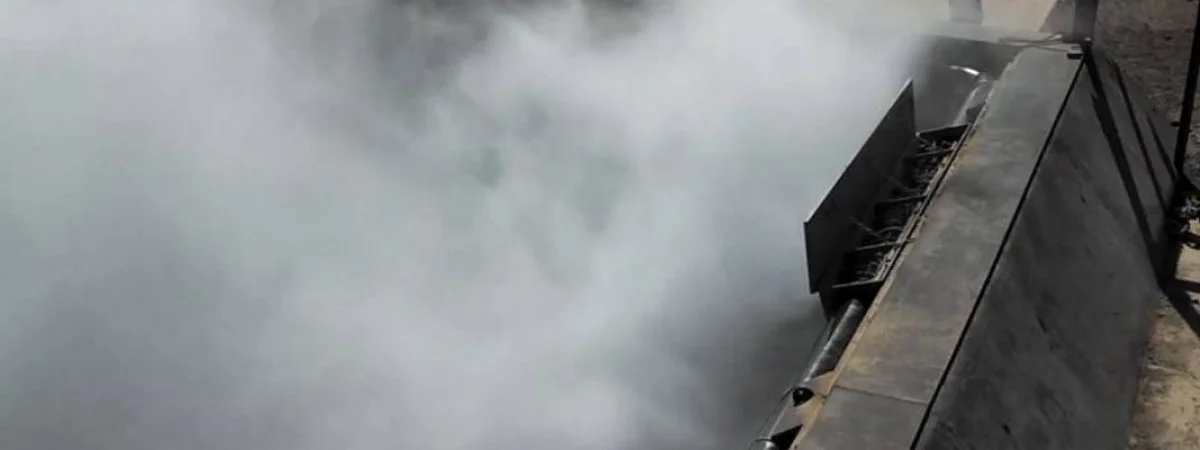
Dry fog systems produce droplets so fine that they behave almost like a gas, staying suspended inside an enclosure and meeting fine dust particles at the point where they are generated. Because the droplets are tiny, very little water reaches the material, which is why dry fog is preferred where added moisture causes problems, such as coal fed to boilers, cement, clinker, fertilisers or minerals that cake when wet.
Dry fog works best where the dust source can be enclosed or partly enclosed with curtains or skirting: conveyor transfer points, crusher feed and discharge chutes, vibrating screens, and wagon or truck loading points. In open, windy areas the fog disperses before it can act. See our dry fog system page for configurations.
- Targets fine respirable dust at source
- Minimal moisture on product, often negligible
- Needs a reliable compressed air supply
- Requires clean, filtered water to protect fine nozzles

When a fog cannon makes more sense
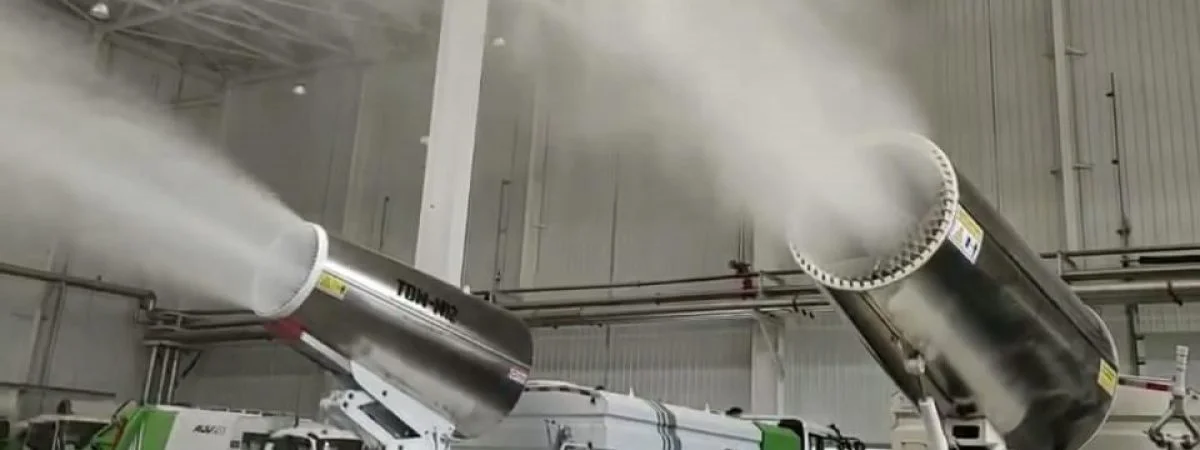
A fog cannon, sometimes called a mist cannon or anti-smog gun, combines atomising nozzles with a high-velocity fan that throws a fine mist over a wide area. Throw distance depends on the model, ranging from short-reach units for building sites to large cannons covering big stockpiles and mine benches. Oscillation and elevation adjustments let one unit cover a broad arc.
Fog cannons suit open, changing areas where enclosure is impossible: stockpiles, demolition work, construction sites, open-cast mine faces, raw material yards and loading areas. Mobile versions mounted on trolleys or trucks move with the activity, which is useful on projects that shift every few days. Our fog cannon page covers sizing and mounting options.
- Covers large open areas from a single point
- Fixed, trolley or vehicle-mounted options
- Wind direction and speed affect coverage
- Water source and power supply must be planned

Wet fog and sprinklers: where they still fit
Not every area needs the finest droplets. These systems are simpler and often the most economical for certain zones.
Wet fog systems
High-pressure pumps create fine droplets without compressed air. A good middle ground for conveyors and semi-enclosed points where a little moisture is acceptable. More on wet fog.
Sprinklers and rain guns
Wet haul roads, stockpile surfaces and yards to stop dust lifting in the first place. Simple and robust, but water-hungry. Coal yard sprinklers.
Plain water spray
Basic nozzles at crusher feed or truck tipping points. Low cost, but adds moisture and is less effective on fine dust. Plain water systems.
How to choose a dust suppression system for your site
Most sites end up with a mix. Work through each dust source in turn.
Map every dust source
List crushers, screens, transfer points, stockpiles, roads, loading and unloading points, noting whether each is enclosed, semi-enclosed or open.
Check moisture tolerance
Where moisture affects product quality, handling or downstream processes, favour dry fog. Where it does not, wet fog or sprinklers may be cheaper.
Assess utilities
Confirm water availability and quality, compressed air capacity and power at each location. These decide what is practical to run.
Match technology to area
Typically: dry fog at enclosed points, wet fog at semi-enclosed points, fog cannons over open areas, sprinklers on roads and stockpile surfaces.
Plan controls and maintenance
Interlock systems with conveyors or crushers so they run only when needed, and plan filter, nozzle and pump maintenance under an AMC.
FAQs: Dry Fog vs Fog Cannon: Choosing a Dust Suppression System
Straight answers to what clients ask us most. Can't find yours? Ask us directly.
Still have a question?
Talk to an engineer: +91 90734 97917 or WhatsApp us. You can also email contact@bjc-global.com.
What is the main difference between dry fog and a fog cannon?
Dry fog creates extremely fine droplets using compressed air and water, designed to capture fine dust inside enclosed or semi-enclosed points with almost no wetting. A fog cannon uses a fan to throw mist over large open areas such as stockpiles and demolition sites. Dry fog works at the source; a fog cannon covers wide spaces where enclosure is not possible.
Does dry fog wet the material?
Very little. Because the droplets are so fine, most of the water is used in capturing airborne dust rather than soaking the material, so moisture added is typically very low. This makes dry fog suitable for materials such as coal, cement, clinker and minerals where extra moisture affects handling, calorific value or product quality.
How far can a fog cannon throw?
It depends on the model, fan size, pump pressure and nozzle arrangement, and wind conditions on the day. Small units suit construction sites and demolition, while larger cannons cover big stockpiles and mine benches. When selecting, match the throw and oscillation angle to the area that actually needs coverage, and allow for prevailing winds at your site.
Which dust suppression system uses the least water?
Dry fog generally uses the least water because of its very fine droplets, followed by wet fog. Fog cannons use moderate quantities, and sprinklers or rain guns use the most. However, the most water-efficient system for one area may not suit another, so a combined layout usually gives the best balance of control and consumption.
What water quality do these systems need?
Fine nozzles block easily, so filtered water is important, especially for dry fog and wet fog. Hard water can cause scaling on nozzles over time, and a softener may help where hardness is high. Treated water from an STP or RO reject can sometimes be used after suitable filtration, which reduces fresh water demand.
Can BJC Global design a combined dust control layout?
Yes. BJC Global designs, supplies, installs and maintains dry fog, wet fog, fog cannon and sprinkler systems. We can arrange a site visit in Delhi NCR, or review drawings and photographs for sites elsewhere in India, then recommend the right mix for each dust source, along with water, air and power requirements and an AMC plan.
Keep reading
Dust Suppression System
Dry fog, fog cannon, wet fog and sprinkler dust suppression for plants, mines, crushers and sites. Book a free site…
Read more
Dust controlDry Fog System
Dry fog dust suppression for conveyors, transfer points, hoppers and crushers, with negligible added moisture. Get a…
Read more
Dust controlFog Cannon Dust Suppression System
Fog cannons and anti-smog guns for construction, demolition and mining sites in Delhi NCR. Supply, setup, AMC. Book a…
Read more
Dust controlWet Fog Dust Control
High-pressure wet fog misting systems for sheds, tipping bays, screens and recycling units. Simple, low-water dust…
Read more
Get a dust control plan for your site
Tell us about your crushers, conveyors, stockpiles and roads. BJC Global will recommend the right mix of dry fog, fog cannons, wet fog and sprinklers. Book a free site visit or get a free quote.